
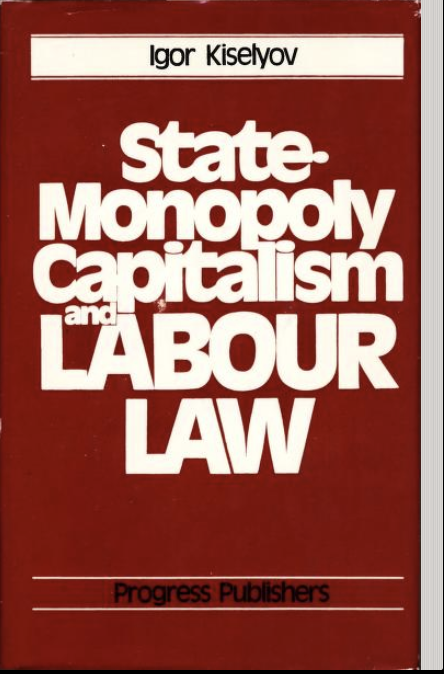
In September, the Carney government introduced Bill C-39, an omnibus that includes an amendment to Section 107 of the Canada Labour Code that would give the Canadian government the broadest strike intervention powers in the G7, allowing the minister to end any strike they consider against the “national interest”, without parliamentary debate, emergency threshold, or fixed time limit. The Bill has rightfully sparked outrage from the labour movement for its attack on freedom of association and the right to strike. This has, in turn, brought labour law into focus for many Canadians. The questions naturally arise: what is the role of labour law, how should the labour movement approach it, and for young people who are disproportionately excluded from its protections, does labour law have any relevance? The book State-Monopoly Capitalism and Labour Law by Igor Kiselyov, is immensely valuable for those wanting answers to these questions from a scientific communist perspective.
In the earliest phase of capitalism, which Marx calls the “manufacture period”, there was not yet the basis of large-scale industry as the precondition for a proletarian class. Instead, the closest thing to unions was guilds of artisans and craftsmen that closely guarded their skills internally. During this time, labour laws were characterized by formal subsumption, which mandated long work hours and low wages, and criminalized unemployment. In Canada, this age corresponded to colonial mercantile capitalism based on trade. Following the Industrial Revolution and the proletarianization of the artisans, formal subsumption was replaced by real subsumption as the logic of capital became self-regulating; the state now stepped in to regulate capitalism from destroying labour power, setting minimum wages and limits on the working day. As laws were based on the dynamics of commodity exchange, trade unions were prohibited as cartels that violated “free competition.” Nevertheless, in Canada, the labour movement was progressing with the development of the factory system, as exemplified by the Knights of Labour and the fight for the eight-hour day.
As capitalism developed into its final monopoly stage, the concentration and centralization of capital coincided with the growth of class consciousness and the strengthening of the labour movement. In Canada, the Winnipeg general strike, the Oshawa GM strike, and the Workers Unity League all began to pressure the bourgeois state to recognize unions and the right to bargain collectively. And these were finally established with the stronger correlation of forces on the side of the proletariat at the close of World War Two, when Canada adopted a modified variant of the Wagner model, known as the Rand formula. This marked the development in Canada of capitalism into its state-monopoly period, which Kiselyov defines as follows:
[The monopolies and the state] have merged, the power of the monopolies and that of the state have become a single mechanism for saving the capitalist system, maximising profits and consolidating the positions of the monopoly bourgeoisie. This has led to a strengthening of the economic, political and ideological role of the bourgeois state, which now actively interferes in the economy and social relations.
Labour law, as an independent branch of bourgeois law, represents one such form of intervention. Its purpose is to ensure the optimal conditions for the bourgeoisie to exploit labour power by legally formalizing the social organization of labour in the interests of the capitalist class. In general, this can be seen as the “carrot and the stick”, with the state acting to reward “legal” and “legitimate” forms of labour organizing that are purely reformist and economistic, and penalizing industrial class struggle unions and political strikes. The former strategy was largely employed in Canada through the 1960s and 1970s, promoting class peace and tying the workers to capitalism by bribing the upper crust or “aristocracy” of labour. However, in the late 1970s and throughout the 1980s, the government increasingly began to infringe on “free” collective bargaining and passed back-to-work legislation even on “legal” strikes. And though these were initially framed as exceptional measures, they were in fact part of what Kiselyov terms the global “neoconservative” turn, which we more commonly call neoliberalism today.
At the same time as this, there was “fissuring” of the workplace, through vertical disintegration, subcontracting, the replacement of standard employment relationships with marginal or flexible employment, the phenomenon we know as the “gig economy”. Youth in Canada are disproportionately affected by this, as they are overrepresented in unemployment and underemployment and face serious barriers entering the job market, with only 15 percent of young workers belonging to a union, and polls showing over 80 percent think there are obstacles to joining a union, such as workplace intimidation, employers spreading misinformation, and too many bureaucratic steps that impede organizing.
Kiselyov correctly frames this as a strategy of monopoly capital to divide the workforce and set them against one another, weaken the labour movement and prevent the growth of industrial unionism. For example, in Canada, the certification process of bargaining units is determined by administrative tribunals, in Ontario by the Labour Relations Board; these have to present a face of impartiality but are, at the end of the day, appendages of the capitalist state. An alternative to this would be what Lenin proposed: independent labour courts that have equal representation of workers on them. Similarly, the ‘right’ to strike in Canada is limited only to the period between collective agreements, and even that is under attack. What the Communist party proposes is a labour bill of rights that would fully guarantee the right to strike and the full freedom to bargain collectively as part of the constitution. This touches on an important point emphasized in the book, which is that although labour law under capitalism is necessarily bourgeois, it is at the same time a terrain of struggle for the labour movement. As Engels said, “Each struggling class must… formulate its own claims as demands of a legal nature in the form of a programme.”
Workers must realize that laws are not neutral and that all the concessions won for them have been against the resistance of the ruling class. This means going beyond struggles solely over wage increases or pension benefits. For example, we demand that capitalist monopolies be put under democratic control, and this does not mean that they merely become crown corporations, or that workers get some shares in them, or even that they become like works councils in Germany, where workers are given token representation; but that workers and trade unions in that industry actually run it for themselves as a public monopoly that is not subject to the whims of the market. These demands, and those Kiselyov lists in chapter four, do not constitute socialism, but they are means by which the working class can turn labour law against capital as part of the wider anti-monopoly alliance, which will prepare the proletariat for the conquest of political power.
That is, of course, much easier said than done, but the first step is for the vanguard of the movement to be conscious of not only its aims and objectives, but the strategy and tactics of its enemy. For us, as young communists, entering into unions, collaborating within anti-monopoly alliances, we must struggle to learn and learn to struggle. Bringing these lessons to organized labour, to young workers, sows the seeds of mobilization. On these fronts, this book is an indispensable aid at approaching the subject comprehensively from a Marxist-Leninist perspective; the application of its concepts to our conditions therefore depends on us.