
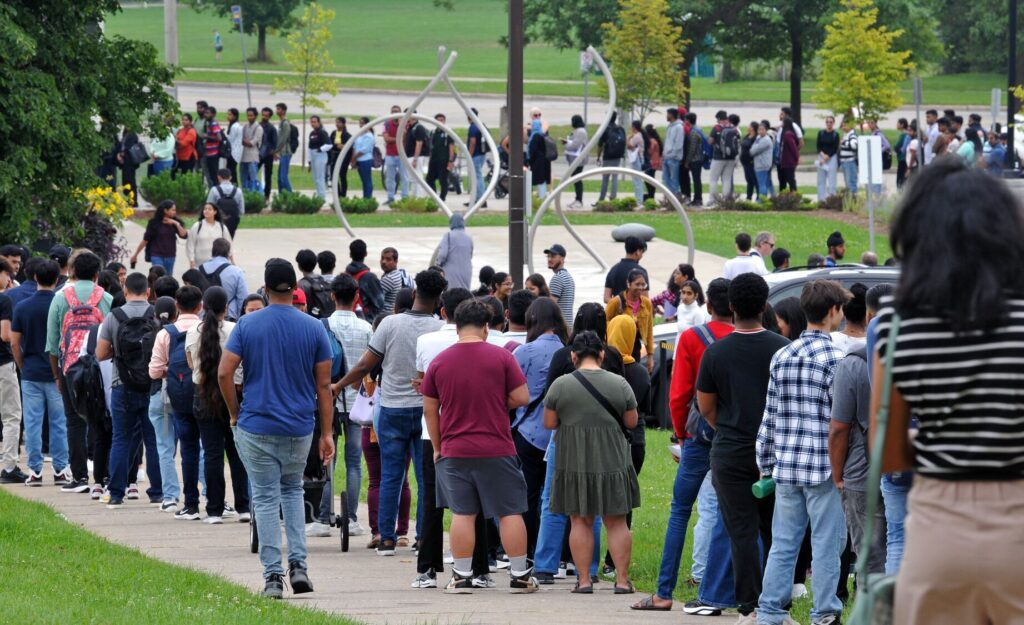
On the last Wednesday of July, over 2,500 people lined up for a job fair in Toronto to work at the Canadian National Exhibition. A record number of people have applied to work at the CNE this summer with over 54,000 applicants for 5,000 contract jobs for the month of August at or near minimum wage. In 2024, 37,000 people applied to work at the CNE and in 2023, 18,000 applied; in both years it was the same as this year with only 5,000 openings. Every year more than 80% of CNE staff are between the ages of 14 and 29.
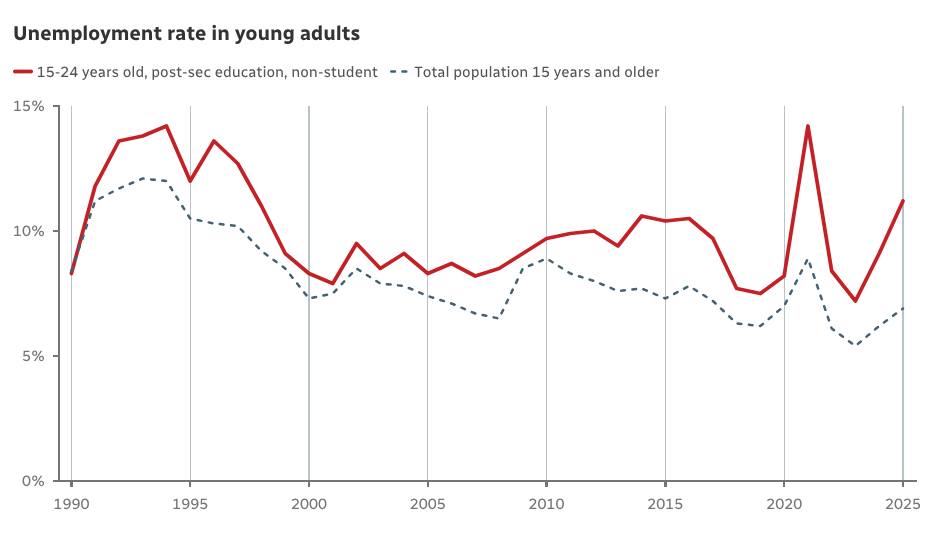
Youth unemployment across the country remains well above pre-pandemic levels, with teenagers, those with no post-secondary education, and recent post-secondary graduates hit the hardest. Summer job prospects for youth continue to worsen this year, after last summer neared 2009 recession levels. Meanwhile, corporate profits continue to rise.
In June 2025, the employment rate for those 15 to 24 fell by 1 percentage point despite the overall employment rate increasing. The current youth unemployment rate of 14.2% is significantly higher than the pre-pandemic (2017-2019) average of 10.8%. From 2019 to 2025 unemployment rose from 14.9% to 22.2% for 14-19 year olds, 9.9% to 13.2% for 20-24 year olds, and from 6.2% to 8.7% for those 25-29. The rate of youth not in education, employment, or training is up 11.3% (most recent figures from 2024) from 10.4% pre-pandemic. In 2023 (most recent figures) after-tax corporate profits across the country totaled $577 billion for the year, over $200 billion (or 55%) higher than in 2019.
It is clear that young workers are being forced to pay for the crisis of capitalism. The cost of living continues to rise, with inflation hitting basic necessities like food and rent. Having 54,000 young people apply for 5,000 month-long contract jobs is just one symptom of the ongoing jobs crisis for youth. People aged 15 to 24 are currently facing the highest unemployment rate outside of the pandemic since the mid-1990s. Those with no post-secondary education have the highest rate of unemployment in the country, and yet those with some post-secondary education are increasingly working in jobs they are overqualified for or are unable to find work at all; the first quarter of 2025 saw the highest jobless rate for recent graduates in at least two decades, excluding the pandemic period. As well, there is the problem of skills mismatch, where in certain industries there is a lack of skilled workers available, while in other industries, there is a glut of workers with qualifications, but very little job openings.
The unemployment rate in Ontario decreased by 0.1% between May and June. This was after May saw the highest unemployment rate since 2016. However, where are the jobs coming from? This year has seen mass layoffs across the province among highly skilled full-time unionised workers across Ontario, particularly in manufacturing and the college sector, largely due to the trade war with our ‘southern neighbors’ and the manufactured crisis in post-secondary education. Now these jobs are being replaced with part-time, precarious and gig work, in low-paying fields. For example, year over year, the trades saw the biggest increase in unemployment, followed closely by manufacturing, whereas retail and services saw the largest increase in employment. Also important to note is that the growth of the population in Canada has been outpacing job growth, which has meant an increase in the reserve army of labour. Ontario has the second lowest labour force participation rate for workers under 25 out of all provinces, with 48.3% not employed or seeking employment, up from 45.1% a year ago.
Two years ago, the ruling class and their spokespersons in parliament and the bourgeois press were lamenting about a labour shortage. We were told that young people were entitled and lazy, they were just unwilling to work. The last two summers have seen countless stories of young people handing out hundreds of job applications in person and waiting in line for hours at job fairs only to never receive an interview or callback. And the statistics reflect these anecdotes.
Our response to the crisis of gig work, hiring agencies, precarious work, cash jobs, and part-time or zero-hour contract jobs is to say that “One Job Should be Enough!” As YCL-LJC, we call for a full employment economy. All young workers must have the right to a decent, safe, and full-time job with compensation that can provide for more than just bare necessities, only scraping by and getting into debt.
And we have the answer! We need to slash our evergrowing military budget in favour of investments into public universal social services. We call for peace and prosperity, not war and austerity! The prime minister has proposed raising the military budget to 150 billion dollars annually by 2035, in line with demands from Trump and NATO. With 150 billion dollars annually, we could build 330,000 new social housing units, or 3,000 new primary schools, or 40 new hospitals, or provide for 1,300,000 full-time jobs at 40 dollars an hour every year.
As Young Communists, our position is clear. We need to agitate for public monopolies on social services, both to create new full-time jobs and to increase the social wage: education, healthcare, childcare, transportation, culture, recreation, and more.
We must also be in the struggles for reforms such as increased wages, shorter work day and work week with no loss in compensation, card-check certification for labour unions, and anti-scab laws. The fight for reforms are essential to building the broader struggle.
All clubs of the YCL-LJC need to make efforts in getting our message out to our generation: leafleting, postering, and petitioning will reach working-class youth. Young people cannot remain dormant in the face of the looming recession. Urgent action is needed to build a working-class movement capable of winning reforms and ultimately class power.