
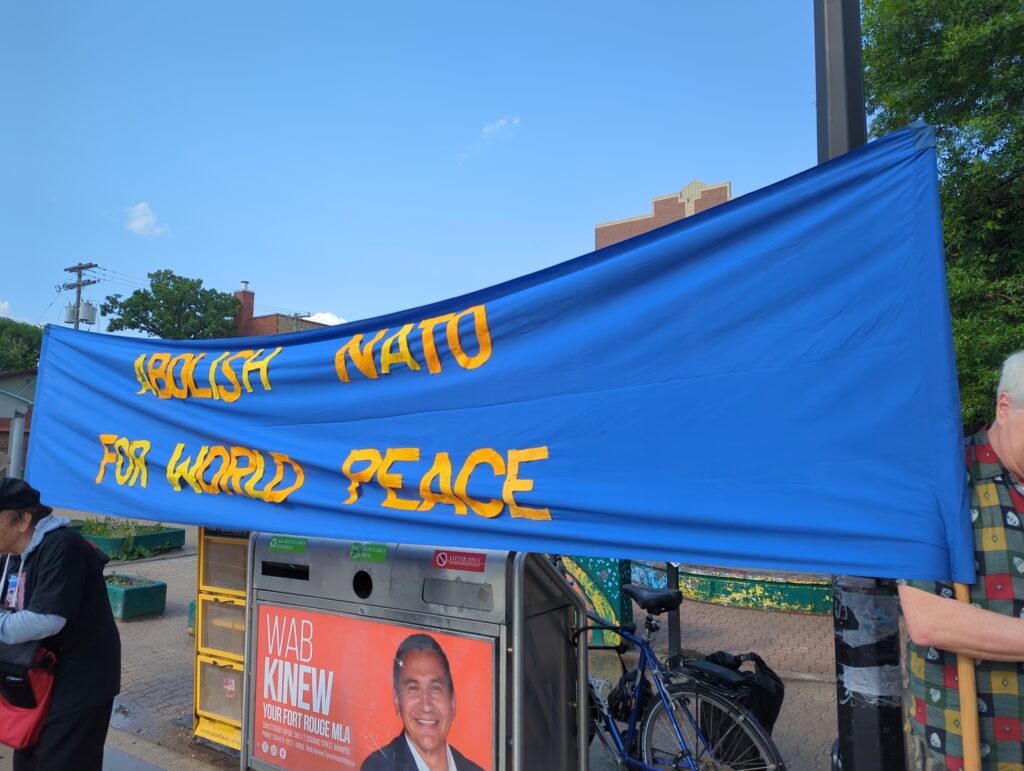
On June 24, the Winnipeg Peace Alliance held an anti-NATO demonstration on the busy corner of River and Osborne in Winnipeg. The event, days after the United States’ bombardment of nuclear research and production facilities in Iran, called for Canada’s withdrawal from NATO. Despite the rain, peace activists showed up in droves to talk to Winnipeggers commuting in Osborne Village about NATO, peace, and military spending.
In Manitoba, the NDP government under Wab Kinew has strongly championed Mark Carney’s commitment to increasing Canada’s participation in NATO and the continued militarization of the Canadian state, at the expense of Canadian sovereignty and world peace. With the U.S.’ imperial aggression in the Middle East as a backdrop, this demonstration was an opportunity to educate Manitobans on Canada’s complicity with U.S. imperialism and the effects of Carney’s commitment to increase military spending to 5 percent of Canada’s GDP on social services federally and provincially. As the Manitoba government uncritically parrots Ottawa’s militaristic ambitions, the province continues to face nursing shortages, record child poverty rates in Winnipeg, thousands of climate refugees displaced by the man-made forest fires in Northern Manitoba, chronic underfunding for municipalities, and a working class struggling with increased rents, interest, and an unstable market due to the capitulation of Ottawa to the oscillating whims of the American empire’s “trade war.” Speakers representing the Winnipeg Peace Alliance, Manitoba Cuba Solidarity, and Canadians for Justice and Peace in the Middle East spoke on the importance of international solidarity and the dangers of Canadian complicity in funding imperial aggression in perpetuating violence against civilians abroad, as well as rampant attacks on the working class at home.
YCL club organizer Nova spoke at the rally, linking military expansion to the struggles of young workers and students in Manitoba. The Communist Party of Canada estimates that the 5 percent of GDP threshold would total approximately $150 billion, enough money to fund 1.7 million full-time jobs paying $40 an hour. With increasing austerity of the public sector and the continued cutting of post-secondary programs across the country, including at the University of Manitoba, young workers are faced with an increasingly precarious access to stable employment and work within their desired fields. Ottawa’s prioritization of militarization continues to throw young workers and graduates to the wolves. If Ottawa’s policy continues, more and more young workers will lose opportunities to contribute to the collective through well-paid employment.
Nova continued, stressing that the province’s championing of Ottawa’s militarization also betrays the responsibility of provinces to manage and support education for the well-being of society. In Manitoba, the average tuition for a student in an undergraduate program is roughly $5,500 a year. As of last year, the University of Manitoba had an undergraduate population of 26,000 students. Less than 1 percent of the proposed $150 billion would fund every University of Manitoba undergraduate’s tuition for a whole year. Post-secondary funds transfers already consist of only 0.1 percent of Canada’s GDP. An increase in military spending to placate the U.S. imperial project comes at the direct cost of education. Without an increase in spending by Ottawa to fund an equitable and free access to training and education to Canadians, the little that is already spent on funding public post-secondary institutions are at risk of further cuts. Canadians are being sold out to the U.S.
The fight for free, democratic, and quality education is interlinked with the fight for peace and demilitarization. The right to free education and training for the Canadian working class is at odds with militarization. We as Young Communists must demand that Ottawa and our provincial governments prioritize free, public education for all. Our slogan “drop fees, not bombs” is more than a catchy phrase: it is a tangible demand rooted in the reality of federal funding transfers. When analyzing budgets, we must demonstrate the feasibility of our demands. The absurd amount of money involved in 5 percent of Canada’s GDP going to meet NATO’s demands could radically transform the funding structures and resources available to post-secondary education in this country. We must remind those we talk to on the streets, in our universities, and within our student groups of these facts.