
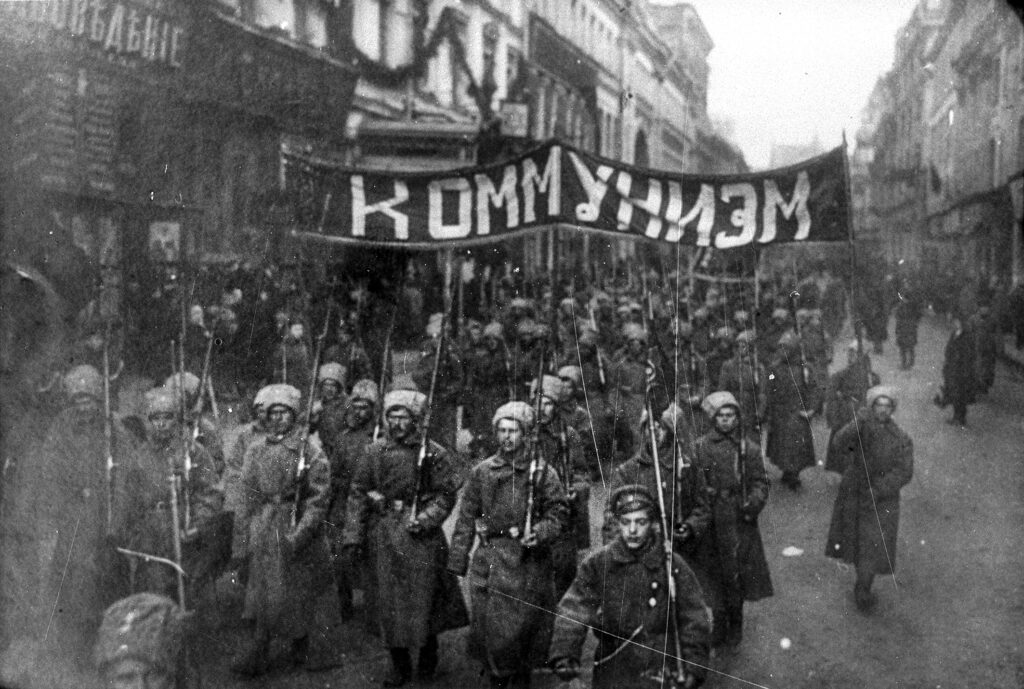
In Russia 109 years ago, there was mass unemployment, rampant inequality, low wages, long hours, and high costs of living. The Provisional government promised to address these issues in due time, but had done nothing but spend more and more on the military, despite the unpopularity of the imperialist war that had been waged for over three years by then. This government justified its existence as the only realistic alternative to the far-right; meanwhile, it had been shown to be collaborating with such forces against the possibility of a workers’ uprising. The government included self-proclaimed socialists, but these “socialists” did not see socialism as anything more than a distant dream, and so used their ministerial positions to support the government’s anti-worker policies. Most of those on the “left” believed that the best that could be hoped for was a greater representation in the upcoming Constituent Assembly elections, so that the “socialists” could either pressure liberals to be a bit nicer, or, if they managed to get a majority, could use the state to manage capitalism in a pro-people manner.
As regards the war, it was justified by these social chauvinists initially on the basis of defence of the “motherland” against “German aggression”, then later as defence of “revolutionary democracy” against the tyranny of the Kaiser. Of course these sophists had their counterparts in the central powers who repeated the same propaganda in an inverted form. But by 1917, such high-sounding phrases sounded empty against the millions dead on both sides. Just as today it is hard for anyone to sincerely believe that NATO is a defensive alliance, or that the imperialist wars in Ukraine or Iran are really about ensuring freedom and democracy. If the story ended just there, we would not have much to learn from the revolution.
But at the same time, there was the ascendance of a higher form of democracy: the Soviets, the councils of workers, peasants, and soldiers. One party had, from the beginning, maintained a consistent, principled line in relation to the state by refusing to enter bourgeois coalitions, had been at the forefront of all mass movements for progress and against reaction, and most crucially, had, from the outbreak of hostilities, decried the war as a conflict for the redivision of the world among capitalist monopolies and called on workers of all countries to turn it into a civil war against “their” national bourgeoisies. On this basis, they gained the trust of the masses and attained a majority in the capital’s Soviet, Petrograd, and from there, the party’s leader, Lenin, demanded that the Soviet seize power from the Provisional Government.
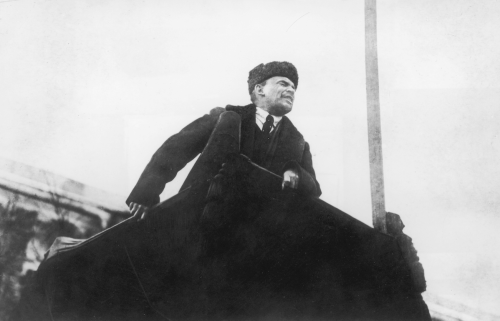
This call led to outcry, even within his party. People argued that the correlation of forces were not strong enough on their side, that Russia’s level of development was too low to justify a workers’ revolution. But the workers themselves had advanced beyond such “theoretical” problems; they were ready to rule. So it was that on November 7, 1917 (October 25 in the Julian Calendar), the Soviet government was declared, and proposed immediate peace, land reform, workers’ control of production, and the right of nations to self-determination. When news of the revolution reached Canada, there was a massive and spontaneous outpouring of support for the workers and peasants of Russia. Demonstrations and mass public meetings in solidarity with the first socialist state took place throughout the country. All of this was, of course, unacceptable to the global ruling class. The weakest link in the chain of imperialism had broken, and this threatened to destroy the entire system. In 1918, revolutionary struggles had broken out all over Europe, and Soviet-style republics were being proclaimed one after another.
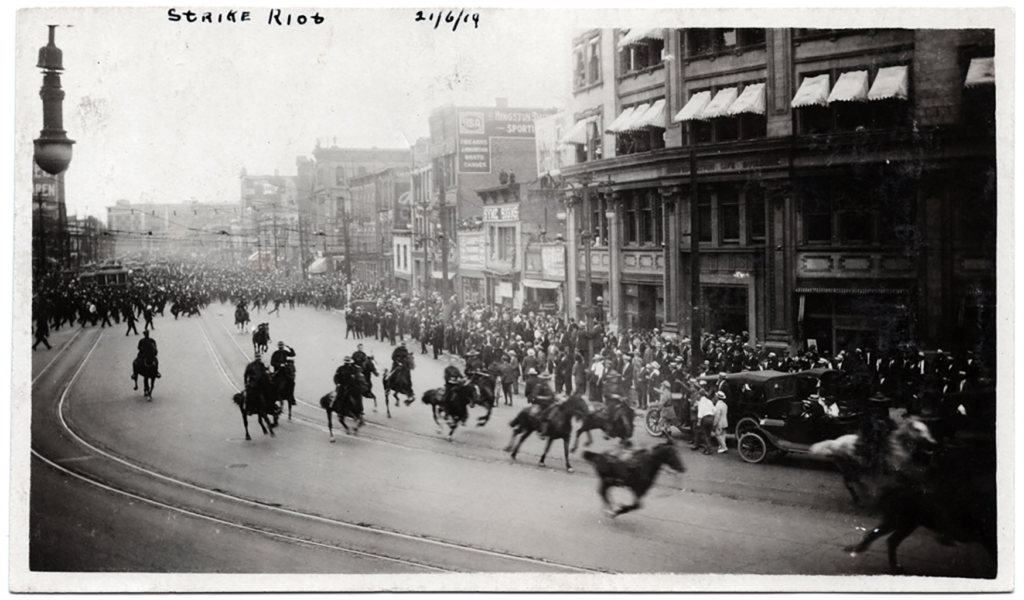
By this time, the Canadian government had sent thousands of soldiers into Russia to support counter-revolutionary white guard forces aimed at “strangling Bolshevism in its cradle.” Yet by now, opposition to the war had grown in Canada too, and the labour movement demanded to “bring our boys home” and ports began to halt shipments sent against Russia. In December 1918, two companies of conscripts bound for Russia mutinied and on May Day 1919, Canadian workers from Vancouver to Montreal, English and French-speaking, celebrated the holiday of the international working class by demonstrating their support for Lenin and Russia. Not long after, the Winnipeg general strike saw Canadian workers take over an entire city and bring all economic activity to a halt. When veterans who had returned disillusioned held a rally in support of the strike, the state responded by sending in the mounted police who fired over a hundred shots into the crowd that had formed, killing two, injuring dozens, then carrying out mass arrests followed by show trials and deportations.
But the defeat of the strike did not mark the defeat of the working class, for just as 1921 marked the end of the Russian Civil War, so too does it mark the founding of the Communist Party of Canada, and one year later, in 1922, the Young Communist League of Canada was founded. It would be impossible to list here all the gains of the Soviet Union following the October Revolution. The construction of socialism, the abolition of homelessness, illiteracy, and unemployment. The establishment of gender and racial equality. The enormous increase in life expectancy and living standards, from semi-feudalism to the space age. The foundation of the Communist International. The decisive role it played in the defeat of fascism in the Second World War. The selfless internationalism it displayed, both in supporting the national liberation causes across the globe against colonialism and imperialism and in providing indispensable aid to socialist republics. All of this hardly scratches the surface.
Everywhere today, the contradiction remains between capital and labour, between social production and private accumulation. Expressions of this primary contradiction can be seen playing out in the mass mobilizations of youth and students across Europe, in the genocide in Gaza, in the imperialist wars in West Asia and Africa. In all the pressing issues our generation faces, the point of convergence is the class struggle. All over Canada, the rise in labour militancy has led the state to respond with back-to-work and anti-strike legislation, highlighting the importance of the demand for a Labour Bill of Rights. The so-called Defence, Security and Resilience Bank and the gutting of our social services to fund the war economy shows the necessity of Canada’s withdrawal from NATO to develop an independent Canadian foreign policy based on peace, international cooperation and solidarity.
In these struggles and more, the YCL learns from the example of the Bolsheviks. We aim to play a vanguard role by injecting class consciousness, building unity in action, and pushing for immediate demands that place the workers in confrontation with state monopoly capitalism, as tactics in our overall strategy around the subjective factor in non-revolutionary conditions, for the working class and their allies to build up their strength for the decisive battle. In particular,
In 1917, the question was whether Russia could have a socialist revolution without having passed through the stage of capitalism; the answer that was shown in practice was unequivocally yes. Today, we see the rotten, parasitic, decaying, moribund capitalist system that subjects us to one absurdity after another to maintain itself. The question is now whether humanity can develop if there is not a socialist revolution. And the answer we get when we see the untold millions all over the world in poverty, in hunger, dying from war, from preventable diseases, from economic sanctions, from unemployment, etc., is no. The 21st century must be the century of transition from capitalism to socialism, and in that struggle for a life with a future, the lessons of October must be a constant guide, and its achievements a constant source of hope.
No matter at what cost, no matter how severe the hardships of the transition period may be—despite disaster, famine and ruin—we shall not flinch; we shall triumphantly carry our cause to its goal.
Lenin, October 14, 1921