
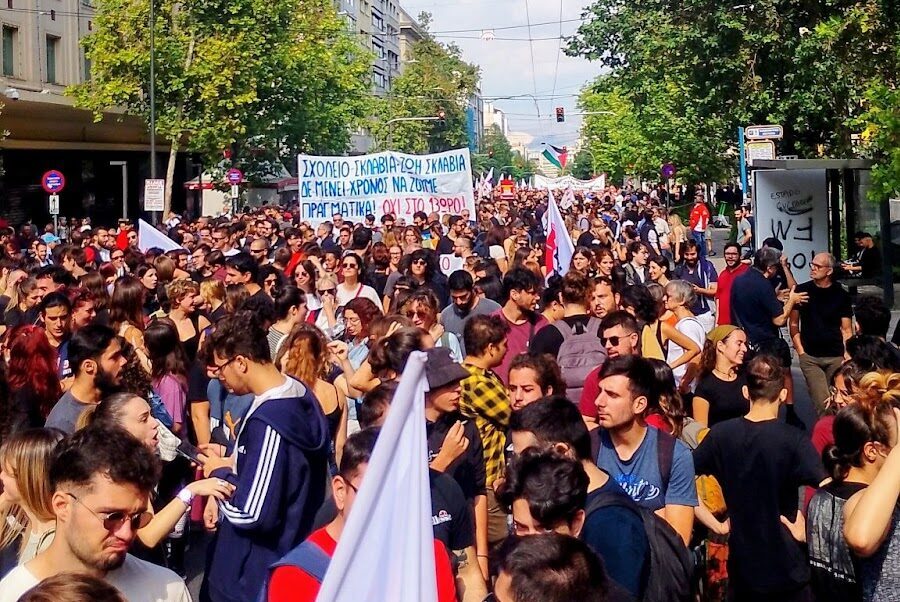
On October 1, trade unionists and their allies conducted a 24-hour strike across all of Greece. The strike was called for and led by the All-Workers Militant Front of Greece (PAME) against the government bill set to increase the work week to six days and introduce 13-hour work days. In 2024, Greek workers had the longest work week on average in the European Union.
On October 14, there was a second country-wide general strike the day before the 13-hour work day bill was debated in parliament. Two days later, the bill passed. The majority of the Confederation of Private Sector Unions (GSEE) did not support either strikes in October, but this did not stop the mass mobilisation of workers in the private sector from participating in the general strikes.
PAME was founded in 1999 as a class struggle and anti-imperialist trade union front committed to transparency and democracy. Since its inception, PAME has led many militant struggles against the employers as well as the policies of the government and European Union and the class they represent. PAME has been responsible for leading many organising drives to create new unions and earn the recognition and trust and respect of the workers. Throughout its history PAME has been committed to proletarian internationalism, which includes being a leading member of the World Federation of Trade Unions. As a demonstration of its commitment to anti-imperialism in recent years, PAME has been instrumental in organising against the Greek state’s participation in the NATO intervention in Ukraine and organising solidarity with the heroic peoples of Palestine and Cuba.
On the occasion of the October 1 general strike, Rebel Youth conducted an interview with Iliana Chatzieustathiou, president of the Commercial Workers of Athens and member of the Communist Youth of Greece (KNE).
RY: How was the strike called?
IC: The workers call for a general assembly to discuss the political issue of the strike and how they will plan the strike. So the general assembly has a high turnout, especially from youth. All workers have the right to speak because it’s a decision that affects their lives. The workers print leaflets that they bring to all workplaces and to the general assemblies. The general goal is trying for every workplace, every supermarket to have its own assembly at the workplace. To have meetings to discuss and set the political line.
RY: What are the demands of the strike?
IC: The first demand and the most basic demand is that the government will not bring the 13-hour work law to Parliament. We demand they don’t vote on this law. Another demand of our sector is the concern of the intensification of the work. For example, the workers of IKEA, who one day work for 4 hours and the next they work for 12 hours. We are demanding a 7-hour work day. We also demand health and safety measures – because of the intensification of work, there is an increase in workplace accidents.
RY: What is the role of young communists in the strike?
IC: The communists play a vanguard role. The communists are those that organise strikes and give it a political aspect.
RY: How do the unemployed youth and students support the strike?
IC: We have a role inside the movement for coordination between the unions, between university students, school students, and the unemployed. Because we have common interests. For university students, if they have to work 13-hour, days this will impact studies. For school-age students, they don’t want to enter the workplace working 13-hour days. For unemployed youth, they participate through neighbourhood sections. They have demands for the right to a job, and against flexible hours.
RY: How many cities are participating today?
IC: Every city is on strike. There are strikes across the country. In some cities like Athens, there are multiple marches.
There are many lessons for young workers in Canada to draw from the general strikes in Greece. However, the main takeaway should be the long march that PAME took to become an organisation able to mobilise country-wide general strikes on political questions. It was constant hard work, consistency and honesty with their fellow workers over many years that earned the trust of the masses.
Today in Canada, in the labour movement, we can see a growing militancy among workers. The problem for the organised labour movement is not, as some put it, a question of elected union officials versus grassroots. Rather, there are two main issues. The first challenge is that the current balance of forces is inadequate. We need to build up the balance of forces around left-centre unity in order to isolate those who call for social dialogue with the bosses and those who refuse to organise at the shop floor. We cannot be content with slogans that have no teeth. And the other challenge that we face is the lack of mass labour political action that is independent of political parties unwilling to break with capital, including the NDP and Québec solidaire.
The organised working class needs a mass political vehicle based on socio-economic demands. With the challenge of corporatist provincial governments, from Alberta ordering teachers back to work to the anti-worker Bill 89 in Quebec, the political question for the working class cannot be boiled down to merely opposing right-wing gifts to the monopolies, or calling to wait for the next election and passing the buck of the political question to the NDP while trying to eke out meager concessions through tripartist “social partnership.”
What young workers here in Canada can take away from the struggles of PAME and the 80-year history of the WFTU is that we need a class struggle orientation in the labour movement. But we must be clear that the ultraleftist call for working outside of organised labour is a mistake. We must reach the youth of the working class where they are, and not isolate ourselves in a self-congratulating sect withdrawn from the movement.
As Lozovsky wrote:
When we speak about the primacy of politics over economics, it does not mean the turning of the trade unions into a political party or the adoption by the trade unions of a purely party programme, or the abolition of all differences between the trade unions and the party. No, this is not what Marx said. Marx emphasised the significance of the trade unions as organisational centres for the broad working masses, and fought against piling the party and the trade unions into one heap. He believed that the political and economic organisations of the proletariat have one and the same aim (the economic emancipation of the proletariat), but each applies its own specific methods in fighting for this aim. He understood primacy over economics in such a way that, in the first instance, he placed the political all-class tasks of the trade unions higher than the private corporative tasks, and secondly, that the political party of the proletariat must define the economic tasks and lead the trade union organisation itself.
Our task as Young Communists in the workforce is to strengthen the labour movement from within, fighting for the broadest unity in action. The union movement is a vehicle that the working class in Canada fought for and created. We need to put fuel in the tank, not siphon it out.