
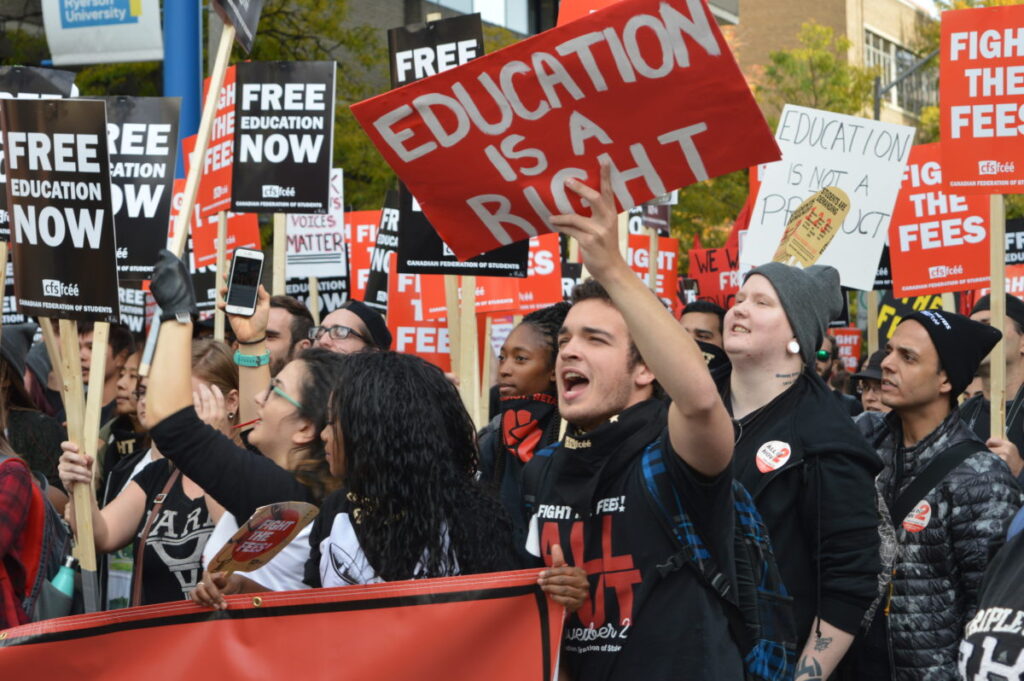
Students across Ontario are doubtless aware of the sweeping changes to OSAP that the Ford government is attempting to implement next fall. The provincial proportion of OSAP is shifting from an 85% potential non-repayable grant structure for eligible students to a maximum of 25% in non-repayable grants. This is a direct attack on students, destroying the ability of students at large to attend university in Ontario or at least graduate without tens of thousands of dollars in debt. Combined with the implementation of Bill 33 last year and the removal of the tuition freeze, the Ontario government’s investment into universities still feels like a spit in the face considering the overall per-student funding in the province is still well below average.
The Young Communist League has condemned the cuts, and comrades in Ontario have stepped up to put in the work and support the student movement and the Canadian Federation of Students (CFS) through the student mobilization committees in Toronto and Ottawa. This is a positive development: as students and young workers, access to education remains a critical demand of our movement. Today, post-secondary education is still the best way to access jobs and work for young people, and any attack on the ability to access it must be staunchly opposed. With that, however, we must maintain a careful balance within the student movement, which today exists as a shell of its former self, and needs to be fostered and rebuilt.
Today, forces within the student movement seek to pull students both to the right and to the ultra-left. At the moment, we’re seeing how, by and large, the CFS in Ontario is uniting students on a largely correct path, but we must be vigilant. More conservative student unions and organizations like the Ontario Undergraduate Student Alliance have condemned the changes with weak words: framing the issue as a lack of consultation, their perspective indicates that they do not really stand against cuts, only in favour of a “seat at the table”. Some student unions across the province have been slower to act, as well: in these cases, it’s vital that students in the movement pressure their unions to take action and have actions in solidarity with students across the province. The only way that the student movement can be revitalized, and students engaged with the demands that can bring about a transformation of our education system, is through a consistent and sustained presence and action organized through our campuses.
At the same time, elements on the ultra-left have been taking the opportunity presented to peel off elements of the student movement for their own gain. Appearing at CFS and student union or mobilization committee town halls, their members have demanded an immediate “one-day strike”, while asserting that this is an inherently more radical demand than the days of action being organized by the CFS-ON. The reality is that a strike is like the heaviest dumbbell in a weight room: you can gain the most by using it, and by practicing it with some consistency, but you must build up the strength to be able to do so at all, and trying to use it too early can result in injury. The one-day strike proposed as an immediate demand only isolates students who are by and large so disengaged they still need to be shown what is happening and shown proof that a movement is emerging. Any kind of coordinated action on the scale of a strike will need to be sustained in order to put pressure on the government of Ontario, and it needs to be built up to that end. If the necessary steps to unite and build up the movement are skipped, this will never materialize.
This is why mobilization work is so critical. The student mobilization committee in Ottawa has been able to foster good relations with many activist groups because of unifying demands, a willingness to meet students where they’re at, and an understanding of the actual realities of the student movement on the ground. Through practice, students have been able to sharpen their skills in organization, class talks and outreach. More and more students are reaching out to join the student mobilization committee, which is an approachable step for students who agree with our demands but are just getting started in student organizing. Through this work, mobilization committees are building bridges with student unions in Toronto and Ottawa, as the student unions trust them to actually put in the work and mobilize students. At the same time, this can inspire the student unions to be closer and actively work together, as well as adopting stronger language and demands, which we’re seeing in Ottawa: the University of Ottawa Students’ Union has listed the demand for free tuition among the three primary demands of the student movement on the flyer jointly distributed by the mobilization committee to thousands of students.
As Young Communists, we fully support the work of the student mobilization committees and the demands for a free and democratic education. We encourage all students to join the March 24 walkout at city hall in Ottawa, as well as the CFS-led rally at Queen’s Park in Toronto at the same time.
Unite and fight for free education!
You may also like
-
International Students Protests Arbitrary and Unfair Rule Changes to Post-Graduate Work Permit at Portage College
-
Militarism in our schools: The case against increasing militarization through student initiatives on campus
-
Northern Alberta Institute of Technology Faces Cuts as Profits Fall
-
Solidarity with Ontario students organizing against cuts to OSAP and cuts to public education!
-
Manitoba Institute of Trades and Technology shutters