
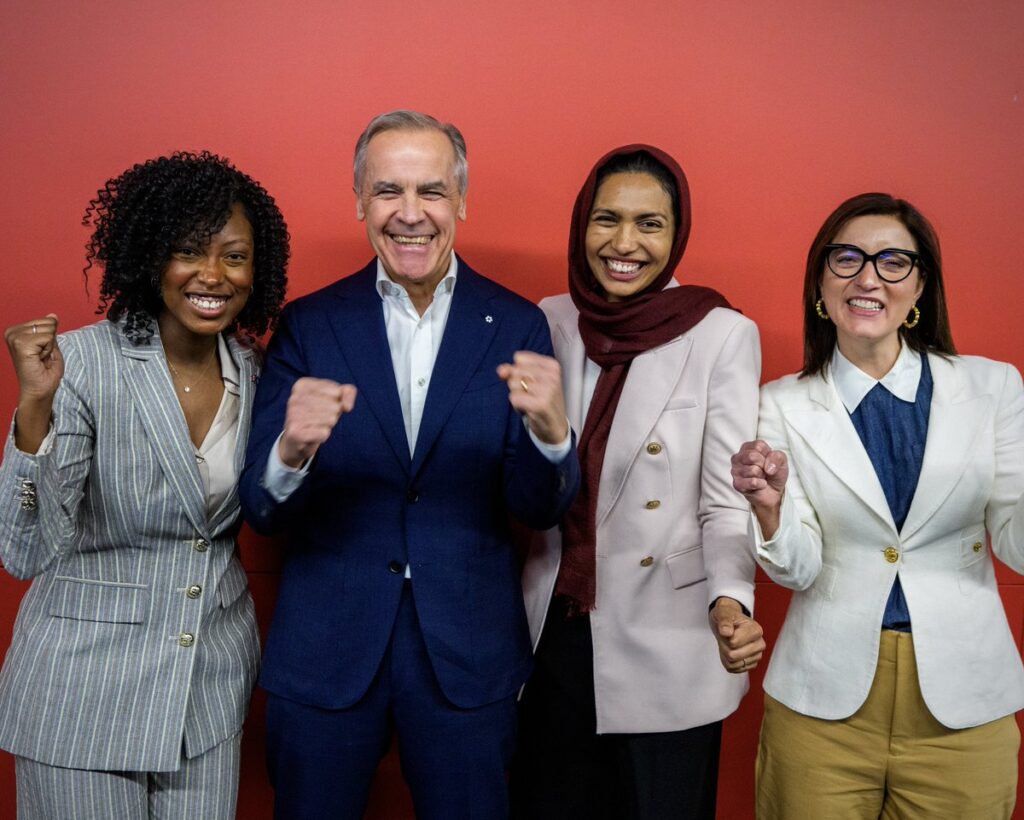
Prime Minister Mark Carney and the Liberal Party have obtained a majority in the House of Commons without a general election. Five members of the opposition crossed the floor and three Liberal candidates won by-elections. Carney has been able to recruit from both the left and the right, with four of the floor crossers coming from the Conservatives and one from the New Democrats. The political diversity of the eight new Liberal members of Parliament demonstrates the class unity under the big tent of Mark Carney’s Liberals and his ‘National Unity’ government.
The by-election candidate in Scarborough, Dolly Begum, also came from the New Democrats. She was a sitting Member of Provincial Parliament and deputy leader of the Ontario NDP before resigning her seat to run for the Liberals. During the campaign in Scarborough, former leader of the Ontario Progressive Conservatives and mayor of Toronto, John Tory, endorsed Begum’s candidacy. Current Ontario PC leader and Premier Doug Ford appealed to voters in the by-elections to help the Liberals get a majority. Ford stated, “as far as I’m concerned, Prime Minister Carney is a good man. He’s a very astute business person. He’s a sharp guy.” Ford went on to recall his first encounter with the PM: “I’ll never forget when I met him the first time, the first words out of his mouth: ‘I’m more conservative than you.’ And I said: ‘well, that sounds good”. Despite the endorsements of two of the most right wing leaders in Ontario history, Begum does have progressive bonafides as the former chair of the Scarborough Health Coalition and the director of the ‘Save Ontario Hydro’ campaign. The jump from deputy leader of the Ontario NDP to Liberal back bench is not a tale of the opportunism of one individual. Rather, the leap paints the picture of how Carney is able to rally the left and right of the ruling class and thus their lackeys behind his project for reduced social services and expanded military spending as their answer to the current crisis of capitalism; to serve the banks fall behind the banker.
On the other end of the spectrum of acceptable bourgeois politics we have Marilyn Gladu – a Conservative MP for over ten years from Sarnia. Her record speaks for itself: she called for the military to be sent to clear railways of Indigenous solidarity demonstrations; supported conversion therapy; called for limitations on access to abortions; she publicly met with the ‘freedom convoy’ in Ottawa. However, she also drafted a bill that passed protecting pensions from corporate bankruptcies. Now, Gladu is in the Liberal party. Both the right of the conservatives and the left of the social democrats have a home in the former Goldman Sachs banker’s government.
The by-election in Terrebonne, Quebec was also noteworthy. Carney’s Liberals were able to crack the nut of a riding that has voted for the Bloc quebécois in every election since its inception. This was definitively a vote for the Liberals and not the candidate, Tatiana Auguste, who only appeared in one out of ten candidate debates. This is a significant breakthrough for the Liberals in a riding that voted overwhelmingly for the Parti québécois in a by-election less than a year ago for the National Assembly of Quebec. The win in Terrebonne alongside the floorcrossings of a Conservative Acadian lawyer and a New Democrat Inuit lawyer, Carney has demonstrated that his appeal to the bourgeois class and its representatives goes beyond English Canada.
The government of Mark Carney has been about class unity since before its inception. In December 2024, the paper of record for Canada’s Tories, the National Post, ran the headline ‘Mark Carney for Conservative Finance Minister’ as rumours were swirling that he may make a run for Liberal leadership and at a time when the coronation of Pierre Poilievre and the Conservatives seemed preordained. From the outset, with the passing of his first budget, Mark Carney received the support of both Conservatives and the Green Party leader to push through mass layoffs of civil servants and to increase the military buildup of the previous Liberal government.
When Lenin wrote “The State and Revolution,” he was describing the state in the era of monopoly capitalism:
Beneath the thin veneer of democracy, there is the reality of the dictatorship of the banks and big corporations. While the people are told that they can democratically decide the direction of the country through elections, in reality, all the real decisions are taken by the boards of directors. The interests of a tiny handful of bankers and capitalists carry much more weight than the votes of millions of ordinary citizens.
Now we live in the era of state monopoly capitalism, where the thin veneer is withering away, leaving us with a banker for prime minister. Mark Carney bringing together conservatives and social democrats into his project is not surprising. It is akin to Paul Desmarais having both Pierre Trudeau and Brian Mulroney on his payroll – united in service to a class.
The only antidote to the unity of the bourgeois class is the unity of the broad working class under the leadership of the industrial proletariat. That is why we as Young Communists cannot simply expose the nature of class rule in this country, but must work even harder to organise the working class and its allies. For this reason, in the face of the war economy, it is our strategy at this time to make all efforts to build the anti-monopoly and anti-imperialist alliance.
You may also like
-
Free Trade and Sovereignty: Canada Must Defend its Sovereignty Through Economic Autonomy!
-
Defending Cuba is defending our future: The No War on Cuba Campaign in Canada
-
Carney’s Canada Investment Summit Puts Canada For Sale
-
Protests sweep Alberta; “tired and done with the United Corruption Party”
-
YCL-LJC’s 30th Convention a sign of unity against a deepening economic crisis