
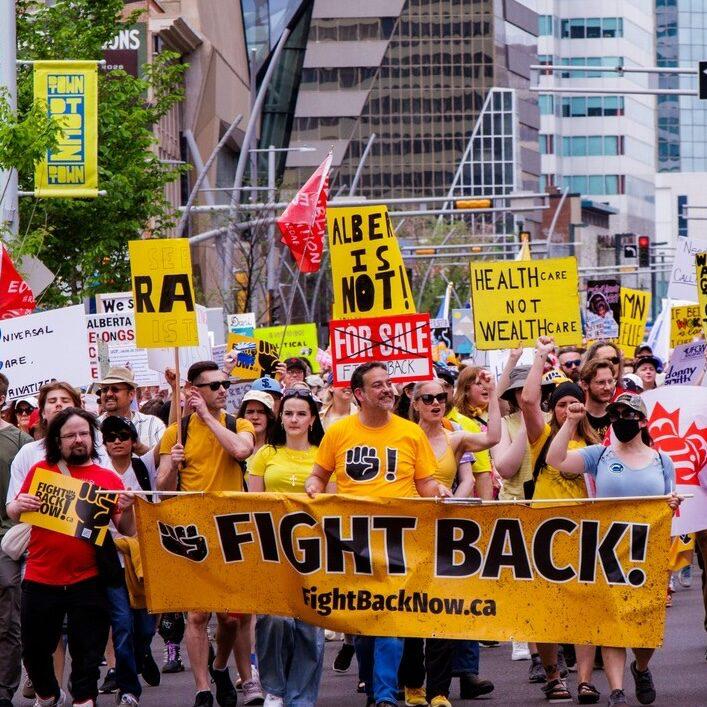
On May 29th thousands of Albertans mobilised as part of the Alberta Federation of Labour’s long-awaited “Fight Back Now” protest, organised in co-operation between labour, Indigenous Nations and local activist groups. Albertans are mobilising against the United Conservative Party government in particular, and against the union between business and government. Rallies erupted across Alberta, with six to seven thousand people at the Edmonton protest, two thousand in Calgary and many more in the fifteen other actions across the province. In Edmonton, this was the largest protest since the climate protests of 2018-9. Albertans from Fort MacMurray to Lethbridge took to the streets to show the UCP and each other that, in the words of Howard Beale, we’re “mad as hell” and we’re “not going to take this anymore!”
These protests erupt at a time when many Albertans are angry at the UCP’s relentless hatred, at their grinding the face of the poor, wrenching austerity’s bolts tighter and tighter. Over their seven years in power, the UCP has overseen the erosion of Alberta’s healthcare. They are starving it of funding, so that the poor simply die in the hospital waiting rooms. Their aim with this is to point to wait times to “prove” the “need” for a two-tier health system, where the rich get better and faster care. Another ongoing source of outrage is the UCP’s corruption—Danielle Smith receives gifts from her corporate sponsors and dances to their tune, handing out lucrative contracts to her friends. A final straw for many has been the UCP’s disregard of democratic rights and rule of law. The government used the notwithstanding clause multiple times last year, both to protect its transphobic legislations and to force striking teachers back to work. Section 33 was invoked pre-emptively, exposing for many Albertans the dictatorship of the bourgeoisie hidden beneath democracy’s smiling face.
This is not to mention the federal government’s continual quashing of CUPW’s strikes the past few years!
Into all this repressed rage was added the issue of the referendum, of Alberta separatism. Just over a year ago, the UCP government passed Bill 54 which lowered the threshold number of signatures to trigger a referendum from 20% to 10% of the voting population, as well as increasing the number of days one has to collect signatures.
On April 30th of last year, Chiefs Sheldon Sunshine of the Sturgeon Lake Cree Nation and Billy-Joe Tuccaro of the Mikisew Cree First Nation issued a cease and desist to Danielle Smith and her government, demanding they stop violating Treaty. In September last year, a protest was held by progressive groups in Edmonton to draw in the sand, to say “this far, but no farther.” This re-ignited the fire in labour’s belly and saw them push to build wider and deeper connections, to build a united and sustained movement of progressive forces. The culmination of all this is the AFL’s Fight Back Now campaign, which aims to build unity in action between labour, indigenous nations and progressive groups and parties.
On April 26th of this year, the AFL used its funds to bring together these groups in a “Civil Society Summit” in which the Jim Brady Club of the YCL participated, bringing to the table our analysis and willingness to do the work. To that end we have been promoting the event, and attended the protest in Edmonton alongside the Communist Party of Canada to show support and share our campaigns.
Edmonton’s rally began with speeches from some of the key organisers. In particular nêhiyaw/Cree Elder Taz spoke of the “great battle” against the UCP—who she compared to the cannibalistic witiko—and the ordinary Albertan, and of the need for us to unite to defend our rights and our land.
At a Mayday rally this year, Gil McGowan spoke of the need to move from “demonstration to disruption.” That today’s protest refused to purchase a parade permit from the city and blocked traffic shows that this was not just radical rhetoric. As the crowd marched we chanted “down with the government”; “Danielle Smith has got to go”; “no more”; “no two tier” and “their time is up.” Around two fifths of folks’ signs were for specific campaigns, such as Friends of Medicare, Water not Coal, Fight Back Now, another two fifths were union signs and the remaining fifth was a mixed assortment ranging from a definition of social murder to caricatures of Danielle Smith to One Piece characters.
The speakers showed the deepening unrest among progressive liberals and social democrats in Alberta—and more importantly a growing willingness by the labour movement to put work and resources into long, sustained campaigns to solve problems through mass struggle. As Cori Longo put it, “they have the money, we have the many” and so we can only succeed through organisation to “take power back” by “building a revolution.” However, there was a noticeable—given how many of their signs and organisers were present—lack of speakers from Water not Coal, a provincial environmentalist group whose petition against coal mining in the Rocky Mountains was recently rejected by the UCP government despite having over 200 thousand signatures, well over the required 178 thousand. Their absence, in contrast to the strong presence of the NDP, whose speaker spoke in support of Carney’s plans to put more pipelines through the Rockies, is telling.
As CLC vice president Siobhan Vipond put it, we are in a class war: “this is a fight between those who have and those who don’t.” What are those who don’t have fighting for? Chief Sunshine tells us we must unite and “speak with one voice” to struggle for land, treaty, and solidarity: “This is our future, and we will defend it by any means necessary.” Migrante brought forward the question of imperialism, emphasizing “migrant rights must begin with international solidarity” and that any discussion of their experiences must start by looking at why people are forced to leave home. Only by exposing “the system that displaces us all” can we all be free. The final speaker described how harmful the UCP’s ongoing reforms to AISH are, making it both more difficult for those on AISH to work, as well as decreasing the amount of money they receive. He spoke for everyone when he said he is “tired and done with the United Corruption Party.”
Overall this protest and the movement it represents is a massive step forward for Alberta. There are conflicts and contradictions within the Fight Back Now movement—with such a large tent this is unavoidable—and in particular, following the referendum in October it may be difficult to retain the momentum and unity within the group. There are three main tendencies, and after October passes and the referendum’s urgency fades, each tendency will work towards their goals.
One tendency hopes to return to “normal,” to remove the UCP—or even just Danielle Smith—from power, and then return to tuning out politics. This group’s base is the better off workers and petty bourgeois, their allegiance is split between the NDP and a revived Progressive Conservative party.
A second tendency aims to shore up our social services and democratic institutions, without changing how society is organised or addressing imperialism. This is by far the largest group, with the greatest concentration among organised workers and progressive minded activists. The NDP aims to get and hold onto their loyalty, but cannot help but betray them when in power.
The final tendency, one hoping for revolutionary change, wants the end of capitalism, imperialism, and colonialism. This tendency is composed of those with class consciousness and a recognition of the balance of power inherent to liberal bourgeois democracy and capitalism.
As communists we must actively participate in the movement to strengthen and unite those tendencies that seek change, provide the correct analysis, and isolate reactionary forces which embed themselves into mass movements. Our duty is to embolden the workers to demand and fight for change which opposes the dominant capitalist structures, instead of returning to the status quo which is rotten at its core. As such, we must curb out those forces who seek to normalize the changes brought on by the UCP or accept the structures which enabled the UCP to engage in their privatization scheme in the first place. The fight to defend public healthcare systems is a means to fight for public monopolies on all social services, and that fight does not end with a defeat of the UCP.
You may also like
-
Free Trade and Sovereignty: Canada Must Defend its Sovereignty Through Economic Autonomy!
-
Defending Cuba is defending our future: The No War on Cuba Campaign in Canada
-
Carney’s Canada Investment Summit Puts Canada For Sale
-
YCL-LJC’s 30th Convention a sign of unity against a deepening economic crisis
-
Class unity and the Liberal majority