
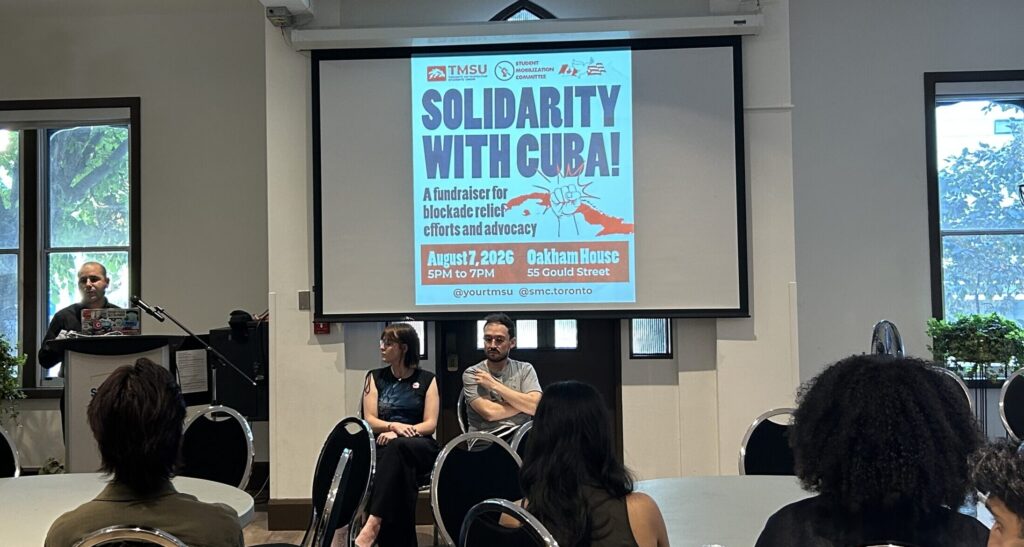
On August 7th, the Toronto Metropolitan Student Union (TMSU), Student Mobilization Committee (SMC), and the Canadian-Cuba Friendship Association (CCFA) held a “Solidarity with Cuba” event at TMUToronto Metropolitan University (TMU). The event brought together students and workers across the city to listen to speakers from the CCFA and the Cuban Consulate describe the aggression which Cuba has faced from the U.S starting with the Cuban Revolution of 1959, the accomplishments of socialism in Cuba despite the blockade, as well as what Canadians can do to help end the criminal blockade on Cuba.
The CCFA emphasized that the foreign policy of the United States, since the Revolution, has been to make the Cuban people suffer and die in hopes this misery would cause them to turn against the Cuban government. Famously, a U.S State Department internal memorandum from 1960, known as the ‘Mallory Memorandum’, stated that the goal of U.S. aggression was “to bring about hunger, desperation and overthrow of government”. Certain aspects of the blockade were highlighted, such as that any goods that are at least 10% manufactured in the U.S cannot be traded to Cuba, that any ship which lands in a Cuban port cannot land in a U.S port for 6 months, and, of course, the complete cut off of oil from Cuba since January 2026. The effects of the Trump administration’s oil blockade were also discussed. Some of the effects discussed were rolling blackouts throughout the country, schools shutting down due to lack of power, hospitals operating at significantly reduced capacity, and a severe food shortage due to the lack of fuel needed to transport food from farms to the people.
Despite all this, the achievements of the Cuban revolution and the resilience of the Cuban people were given the time they deserved to be discussed. To list all the achievements of the Cuban revolution would be too long, as you could fill an entire book with everything the Cuban people have accomplished. However, as was highlighted to students who attended, the Cuban emphasis on education as a right for all was very relevant for students here. For instance, the virtual eradication of illiteracy, which has been maintained since the literacy campaign which began just after the success of the revolution, was highlighted as a shining example of what can be achieved when a society puts people before profit. Most relevant was that education is guaranteed as free, accessible, and of high quality from the lowest to the highest levels of education. In fact, free education is a constitutionally enshrined right in Cuba. In contrast, in Canada, the right of students to an education is treated with impunity when the potential for profit is possible.
This brings us to an important point raised at the event: if Cuba, A country facing an economic blockade limiting their access to resources can provide free education for its youth, why can’t the Canadian government provide free education given its relative wealth The answer is that the Canadian government is beholden and has merged with the interests of the big monopolies. In contrast, in Cuba, the government is a government of the people, of those who work and toil. This is borne out by how the Cuban government can provide free education for all, whereas provincial governments throughout the country have chronically underfunded post-secondary education. Ontario students came out in numbers not seen before in years to tell the Ford government that they would not accept the cuts to OSAP and the privatization of education. Did the Ford government listen to the will of young people? Absolutely not! The reason being that they serve the interests of profit, which stands opposed to the interests of the people.
From this point, the following two points were discussed: what can students in Canada do to help Cuba, and how does the struggle of Cubans relate to the struggle of students here? Firstly, the CCFA emphasized how important it is to get involved in the Cuba solidarity movement. This means coming out for events, but even more importantly, taking some time whenever possible to help hand out leaflets, put up posters, and participate in other outreach of that nature. The best way we can help is not only to provide aid but to build the Cuba solidarity movement so we can put greater pressure on our government to end their complicity and cooperation in the blockade.
Finally, it is important to note that there is a convergence of struggle between the student struggle here and the struggle of Cubans against the blockade. The relevance for students in attendance was clear. It is the power of monopolies and their interests that want to make our education more costly and eventually completely privatize it. Our fight against the OSAP cuts is a fight put on the agenda due to this capitalist system, which puts profit before people. It is the same system which maintains the power of monopolies and seeks to destroy Cuba, to open Cuba up for exploitation by the monopolies. It is profit which attacks students here and profit which attacks Cubans there. For this reason, as young communists, we applaud the efforts of all the groups involved in mobilizing for this event. As students in Toronto and Canada at large fight against the attacks on our education, we hope solidarity continues to be shown with Cuba because we all share this struggle for a better world from the streets of Toronto to the streets of Havana.
You may also like
-
Celebrating 100 Years of Fidel in the Greater Toronto Area
-
On the Centenary of Fidel Castro’s Birth
-
YCL-LJC celebrates the World Anti-Imperialist Day of Solidarity with the Peoples’ Struggle by honouring Moncada Day!
-
Immediate release of comrade Miloš Karavezić!
-
Let Cuba Live! Canadian Cuban solidarity movement mobilizes to defend against US escalations