
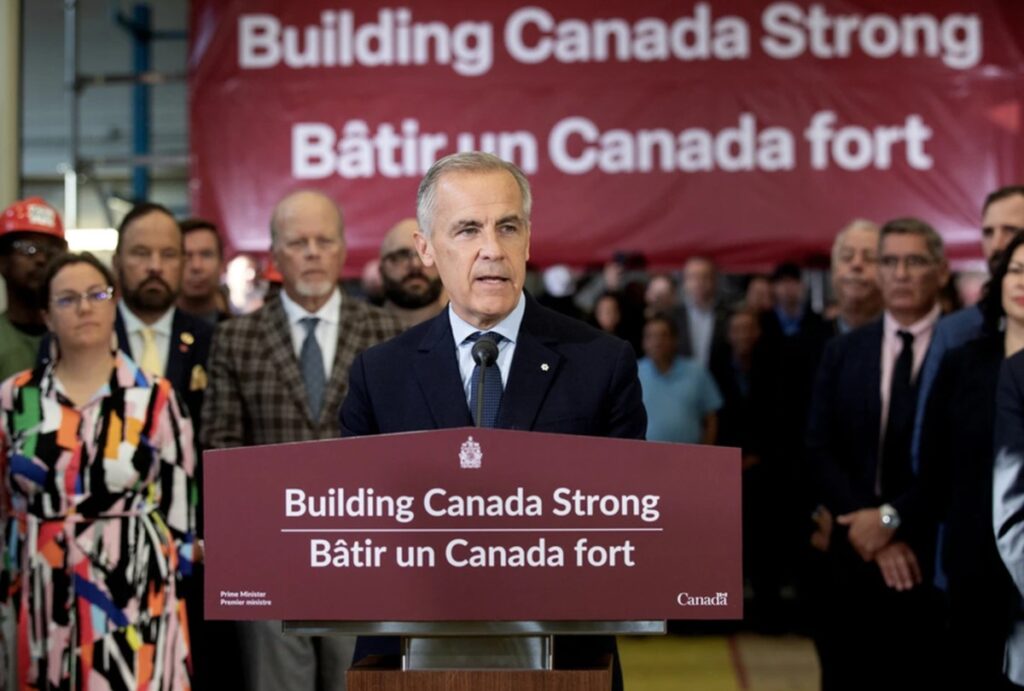
On September 14-15, the first-ever Canada Investment Summit will be held with the goal of attracting $1 trillion in total investment in Canada over the next five years, to offset the $1 trillion foreign capital flight that occurred over the past decade. Blackstone Inc. president Jon Gray, BlackRock Inc.’s Larry Fink and Barclays PLC chief executive CS Venkatakrishnan are among those expected to attend alongside representatives from major state-owned funds, including Saudi Arabia’s Public Investment Fund and Temasek Holdings chief executive Dilhan Pillay. When announcing the summit, Ottawa said:
“Canada has what the world wants. We are a superpower in both clean and conventional energy, with vast deposits of critical minerals. We have free trade deals with countries covering 1.5 billion people and are the most-tax competitive country in the G7 for new business investment. We have one of the world’s most educated workforces, the lowest net debt-to-GDP ratio in the G7, and the fiscal capacity to act decisively.”
That much is true, but the next sentence, “our government is ensuring that these strengths benefit all Canadians, as we build a Canada for all” is a blatant lie to Canadians. Are cuts of up to 15% to Canada’s public services, that will lead to 40,000 jobs being lost (after 10,000 federal jobs have already been eliminated), building a “Canada for all”? Does Canada Post’s “plans to cut door-to-door delivery, to replace postal workers with community mailboxes, speed up deliveries through subcontracted gig labour, and quietly hand over profitable routes to private couriers” benefit all Canadians?
One would think that given Canada’s low debt-to-GDP ratio, there would be room in the budget to further fund programs like pharmacare, dental care and child care. But apparently, there is only room for $1.8 billion over four years to increase federal policing and a whopping $9.3 billion more for the military just this fiscal year, with the overall budget to increase to $150 billion per year by 2035. Canada is, of course, not in any war, except its never-ending war against the global working class, so it is hard to see why the latter should pay to arm their own enemies. Another $35 billion was spent on a tar sands pipeline through British Columbia, violating Indigenous treaty rights, and in spite of the dangers of climate change that have become more and more apparent here with the increasing wildfires. That oil is most likely going to be sent to the United States anyway and bought back after it is refined, a movement that is quite beneficial to capital, though less so for Canadians. And of course the Carney government has only deigned to spare a measly $8.3 million for Cuba despite the strangling blockade imposed by the United States, and needless to say hasn’t provided a drop of oil.
Well then, we can safely say the summit is not about helping all Canadians; what is it actually for? According to people familiar with the planning, “Canadian officials are working on an extensive deal book for the summit that will include a list of government-backed initiatives that investors can participate in, as well as projects by private and public companies.” But one does not invest without hoping for a greater return on their investment, so what this “deal book” will have to show is profitability, and one of the best ways of achieving that is through privatization, which Carney has already announced with airports, and when he was still a Goldman Sachs executive, tried with Hydro One. Even besides outright privatization, looking at the kinds of government initiatives going on can paint a vivid picture. To “address” the housing crisis in Toronto, a $2.7 billion plan was announced, $1.8 billion of which went to low-interest loans for private developers to create 3,700 rental homes that won’t even be subject to Ontario’s annual rent-increase cap. In other words, renters’ tax money will go toward a very lucrative subsidy to Toronto’s landlords.
But it’s not all about Carney; the summit will also be co-hosted by the Canada Pension Plan Investment Board (CPPIB) and the Public Sector Pension Investment Board. Pensions have themselves become a luxury inaccessible to most Canadians. Today, less than 40% of workers have access to a pension plan at work. In the private sector, fewer than 25% of workers have a workplace pension. But if they are lucky enough to have one, workers have little say in where the investments go; for example, the Canadian Pension Plan (CPP) recently increased its investments in companies tied to Israel by $23 billion, more than doubling what it was just two years ago. As a Crown corporation, the CPPIB operates as a private investor due to the interests and economic incentives of the bourgeois state. The CPP, as a result, has no regard for the sources of its profits, whether they be from investments in the war economy or the dispossession of Indigenous communities through resource extraction.
Capital is itself the embodiment of exploitation, its valourization made possible only through appropriating the surplus labour of producers. The logic of capital is toward endless self expansion, and this summit is only another example of that. Canada’s domestic bourgeoisie seeks foreign capital to satiate its bottomless hunger for accumulation, just as when the markets here are over saturated, foreign markets are plundered and the workers there are squeezed by Canadian mining companies and the like. Such is the network that makes up the world imperialist system, chains of interdependence that keep the working class in bondage. But they are not helpless victims in this struggle. Workers across the country are engaged in militant action against capital’s assault. For the YCL’s part, we struggle against the privatization of education impacting students and the precarity facing young workers. Through united action, the working class and its allies can defeat any plans its enemies draw up at this “first ever” summit or any one after, for real power lies not in the magnates of finance capital but in those who make the world run through their labour.
You may also like
-
Free Trade and Sovereignty: Canada Must Defend its Sovereignty Through Economic Autonomy!
-
Defending Cuba is defending our future: The No War on Cuba Campaign in Canada
-
Protests sweep Alberta; “tired and done with the United Corruption Party”
-
YCL-LJC’s 30th Convention a sign of unity against a deepening economic crisis
-
Class unity and the Liberal majority