
Since the start of 2026, the Liberal Carney government has stuck to its drive to feed the war economy and disinvestment from social services, forcing Canadian workers to face the effects of the ongoing trade war with the United States. As retaliatory tariffs hit Canadian agriculture and manufacturing, Canadian workers are left to pay the increased prices by the monopolies which fund and control our logistic systems, grocery stores, financial institutions, and the production of vital infrastructure to maintain our energy grid. The trade war, this time a result of failed negotiations between Ottawa and Washington on the renewal of the United States-Mexico-Canada (USMCA) agreement, represents the effects of state monopoly capitalism run amok.
Vital sectors such as steel, auto, and transportation have long been held in private hands on both sides of the border. The Canadian auto industry, which fell victim to the 1965 Auto-pact agreement between Canada and the United States, is merely a network of branch plants for transnational monopolies. Despite Canadian investment into the sector, through economic integration with the United States, the profits cross the border via the banking monopolies, away from the regions which employ thousands to manufacture automobiles. Following NAFTA, and then further exaggerated by USMCA, this trend hit other secondary sectors, often seeing manufacturing shift down south to the United States or to Mexico.
As concerns Canada’s primary sectors, for most of Canada’s history Canada has remained a source of cheap export to foreign monopolies. What little protections existed for these industries, such as the Wheat Board or various provincial agricultural boards, have been privatized and sold to facilitate the free flow of capital out of the country. Historically, following the de-regulation or the privatization of elements of Canada’s primary sector, exports increase and Canadians must depend on imports to meet the needs of manufacturing and subsistence. One of the sticking points between the Trump and Carney governments in the most recent trade talks was the American demand of the weakening -if not full dismantling- of the regulations on Canadian dairy in order to introduce American dairy into Canadian markets while buying Canadian dairy for cheap. Proving once again that the end goal is the totalization of the free market under entrenched economic integration.
Although Carney walked away from these trade talks, we must remain critical of his reasoning and we must stand resolute in our opposition to USMCA and other similar free trade agreements. We must also understand that Carney, the banker that he is, has not pulled out on the grounds of opposition to free trade, merely the terms in which Canadian monopolists are to enter into free trade. If Canadian monopolists were to unequivocally benefit from the wholesale dismantling of protections on dairy, it would have been done.
The pull of finance capital has never been as strong in Canada as it is now. September marked the first Canada Investment Summit, a scheme that could only be conceived of by a banker. To help stimulate privately developed nation building projects, Carney has told the world to speculate on the construction of infrastructure. Our “nation building” is for sale. Per the April announcement from the Prime Minister’s Office: “over the past year, Canada’s new government embarked on a clear mission to position Canada as a top destination for foreign direct investment (FDI).” In the first half of 2026, Canada saw $44.7 billion in FDI, below last year at $54.7 billion. However, the make up of FDI is consistent with last year’s; American monopolies investing directly into mineral extraction and energy continue to dominate FDI into the country. The Canada Investment Summit can thus be understood as a means to ensure that Bay street sees more FDI and Canadian monopolies maintain their share of increased FDI, a losing scheme for Canadian workers. Over the past decade, for every one dollar of FDI that entered Canada, two dollars exited. Since 2015, Canada has accounted for nearly 10% of global outward FDI, exporting more than any other country except the U.S and China, who happen to be the principal sources of FDI entering this country. As FDI increases, Canada’s role is being re-engineered as a resource extraction and energy supply for the U.S. war economy, of which Canada’s own pivot to the war economy serves as a means to prop up the yankee’s manufactural shortcomings or need to rapidly increase NATO allies supplies to maintain the hegemonic position of the yankee imperial machine. Carney spoke of “elbows up,” but clearly Ottawa has put their hands up as finance monopoly capital, domestically and internationally, take everything they can for their own means.
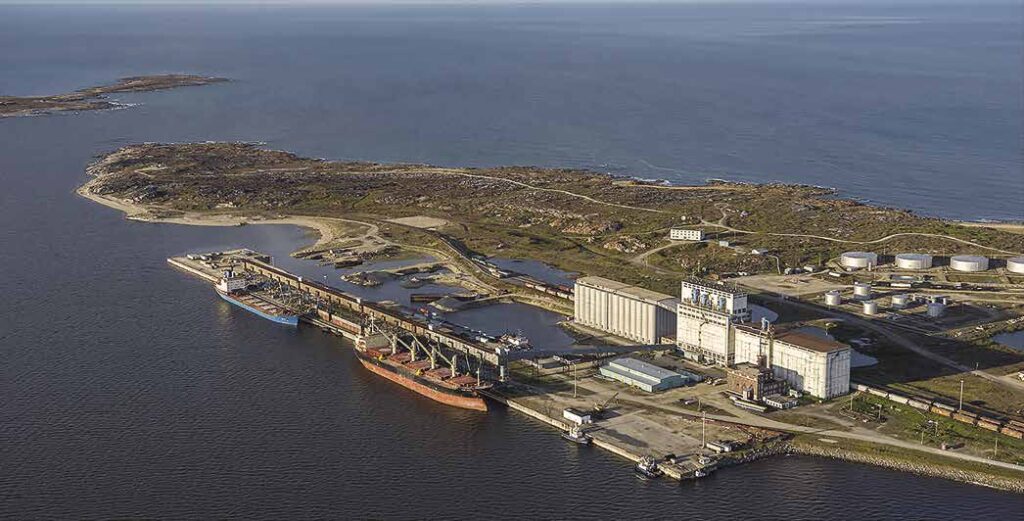
Carney’s big so-called nation building projects he has steamrolled through parliament, often overriding Indigenous land rights recognized under the United Nation’s Declaration on the Rights of Indigenous Peoples (UNDRIP), have nearly all been aimed at exporting Canadian resources to the world market. The port of Churchill expansion in Manitoba has become one of Carney’s most favoured projects. The project, presented as costing $57 billion, is the most ambitious of the projects presented at the Canada Investment Summit. It’s goal is to link the arctic as a site of export of Canadian goods. Clearly the priority is to use foreign funds to further integrate Canada with the world market as a source of exports. The export of crude oil, grains, and other goods could otherwise fuel Canada’s manufacturing base, a sector which comprises less than 15% of all Canadian jobs. Instead, priority is given to offloading manufacturing abroad and developing export corridors as a backdoor for the militarization of the Arctic under the NATO and NORAD-led Canadian Armed Forces. To “build Canada strong,” Carney is selling off the country to investors, and giving carte blanche to American military interests.
In Alberta, the oil monopolies have the provincial United Conservative Party and the federal Carney Liberal Party in their pockets. They have, on one hand, supported a memorandum of understanding between Ottawa and Edmonton to expedite east-west pipeline construction, while on the other hand, been ardent supporters of the ongoing Alberta separatist movement to further integrate Alberta with the United States, starting with oil magnates and private health insurance providers. Meanwhile, the Alberta Federation of Labour is holding its largest campaign in decades, as wages remain stagnant and healthcare is under consistent attack of privatization. The attention is on Alberta separation as a means to strengthen the province, instead of responding to the demands of the working class. In Quebec, the Parti Québécois, representing the interests of small nation chauvinists, have called for a deepening of economic ties with the United States, including increased access to Quebec’s nationalized power grid. In both provinces, the actual interests of the workers are left to the side, as Canada’s already haphazard power grid, whether through hydro-electric infrastructure or crude oil, is up for grabs to fuel the American-led war economy. For Canadian monopolies, USMCA is not needed to undermine Canadian sovereignty; other methods exist.
The answer to the integration of Canada’s economy with global finance capital is not protectionism, the opposite of free-trade. Protectionism harms the working class, and serves only to benefit a different camp of the bourgeoisie. The solution instead is the development of Canada’s sovereignty over its primary and secondary industries through public ownership and democratic control. Too often we have seen in Canada Crown Corporations or public utilities act undemocratically and sell off their output to make a profit. Industry ought to be tied to the needs of the population. Trade must be multilateral and mutually beneficial. Energy corridors should run east to west with the intention of powering local extraction and manufacturing capacities, and exporting only what is necessary to make up for production shortfalls or to collaborate with trade partners. Too long has Canada’s economy served as a means to enrich the U.S. and foreign capital. Too long have young Canadian workers been thrown into sectors which are subservient to the demands of foreign capital to the point of busting unions and laying off workers as soon as the market hiccups. Too long has the Canadian bourgeoisie’s representatives in parliament parcelled off vital sectors of Canadian society to enrich the financial sector.
We say no to free-trade, no to Canada as a source of cheap export, and no to finance capital dictating the makeup of our economy. For a future with socialism, we must plan for economic prosperity, democratic control, and trade which benefits the workers.
You may also like
-
The International Situation: As 2026 comes to a close, inter-imperialist rivalries intensify
-
Defending Cuba is defending our future: The No War on Cuba Campaign in Canada
-
Carney’s Canada Investment Summit Puts Canada For Sale
-
Protests sweep Alberta; “tired and done with the United Corruption Party”
-
YCL-LJC’s 30th Convention a sign of unity against a deepening economic crisis